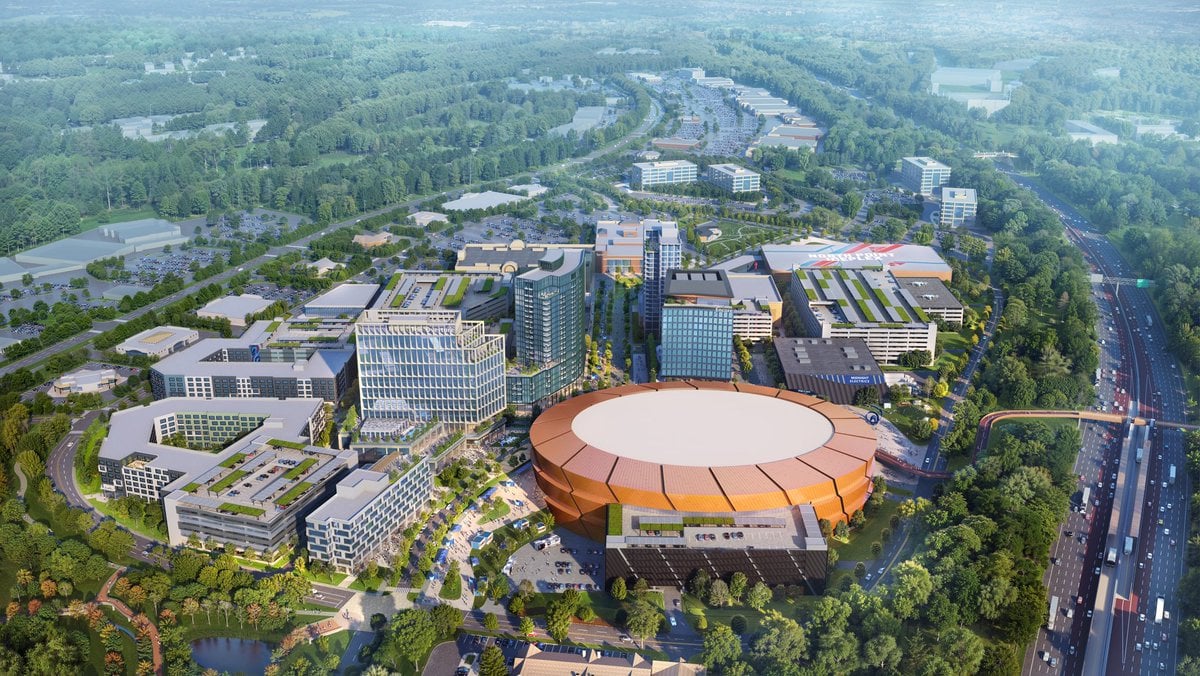
Alpharetta's City Council approved the rezoning of the North Point Mall site early Tuesday morning, ending a hearing that ran five and a half hours and required the council to suspend its own procedural rules so that everyone who wanted to speak could. The vote was four to three. That margin, and that hour, tell you more about this project than the headline does.
Here is what the council actually approved: a master plan amendment and rezoning across roughly ninety-nine acres, allowing a mixed-use district anchored by a 20,000-seat arena built to NHL specifications. Alongside it, a 4,000-seat music venue designed to convert to a performing arts center, a practice facility and community ice rink, a rebuilt movie theater, hotel and conference space, roughly 750,000 square feet of office, 565,000 square feet of dining and retail, 1,385 rental units, and twenty-six acres of public parks and plazas. The developer is Jamestown, the firm behind Ponce City Market and, closer to home, Avalon.
Seventy-four conditions were attached to the approval. That is the detail most coverage has skipped, and it is the one that matters if you live nearby. This was not a blank check. The conditions govern phasing, density, design review and contingencies, and they are the mechanism by which the city retains control over what actually gets built.
Three of them are worth knowing.
The apartments are phased, not immediate. Every article you have read reports 1,385 rental units as though they arrive at once. They do not. The first phase is roughly 600 units, with subsequent phases building out over time through 2034 and later stages tied to project milestones. The full timeline runs about eight years. That directly addresses the density objection that nearly defeated this vote, and it is the single most useful fact for anyone worried about what happens to their commute next spring.
Macy's and Dillard's are staying. Coverage has largely framed this as demolishing the mall. In fact both anchor department stores remain, along with the parking decks, supported by roughly $101 million in renovation investment. Two surviving anchors is unusual in a project of this type and means retail continuity rather than a clean slate.
Every building requires design review. The city retains approval over architectural scale and how new construction integrates with what surrounds it. For a market that has spent thirty years caring a great deal about what things look like, that is not a small provision.
The contingency remains the whole story. This project is conditioned on the National Hockey League awarding Atlanta an expansion franchise and selecting this site for it. If the league chooses differently, the plan has to be reimagined. A separate group is pursuing a hockey project roughly six miles north in Forsyth County. What was approved on Monday night is permission, not a commitment.
We say that plainly because the distinction matters if you own a home nearby. Nothing about Tuesday's vote changes what your house is worth this month, and anyone telling you otherwise is guessing.
What is worth watching is the density conversation. The rental units were the sticking point, along with traffic, and they are why three council members voted no. North Atlanta has spent thirty years as a low-density, owner-occupied market. A project of this scale represents a different pattern, and reasonable people in Alpharetta disagree sharply about whether that is welcome. That disagreement is not going away with one vote — it will resurface at every phase this project still has to clear.
The second thing worth watching is geography. Alpharetta has had one center of gravity for most of its modern history, then two once Avalon opened. A developed North Point creates a third, where GA 400 meets the Old Milton corridor. Over a long horizon that reshapes how people move through the area, which routes feel congested, and which addresses feel close to something. That is a slower and less dramatic story than an arena, and it is the one more likely to affect daily life in Alpharetta, Milton, Roswell and Johns Creek.
City administrator Chris Lagerbloom has said he does not expect construction to begin before the end of this year, and that projects of this size take time. That is the right frame. Redevelopment at this scale unfolds over a decade, and what gets built rarely matches the renderings exactly.
Our advice to clients this week is the same as it was two weeks ago: pay attention, do not react. If you are weighing a move in the next year or two and want to talk through how any of this bears on your specific street, the Bonnie Smith Group is glad to have that conversation.